
Medications in one binder. Care plans in another. Shift updates buried in a message thread.
When information sits in that many places, even a routine question can send someone searching.
The work is connected. The records should be, too.
Assisted living software for small communities should bring medication records, resident documentation, and daily responsibilities together without making the work more complicated.
Small Communities, Familiar Responsibilities
A small resident count is not a small job.
Small settings make up a significant part of residential care. CDC’s 2025 national estimates indicate that approximately 56.5% of qualifying U.S. residential care communities had 25 beds or fewer. That measures the share of communities, not residents.
Fewer beds do not necessarily mean lower resident assistance needs. In CDC’s analysis of 2020 resident characteristics, 79% of residents in communities with 4 to 25 beds needed help with bathing, compared with 60% in communities with more than 50 beds.
The name on your license and the requirements you follow may differ by state. Many daily documentation needs overlap, but the details of your setting still matter. Software should support that shared work while accommodating the records and responsibilities specific to your community.
Whether you run a small community in Oregon, Wisconsin, Texas, Florida, or somewhere in between, the starting point is the same: how does your team handle the information it needs each day?
What Small Residential Care Teams Need From Software
Useful software should make three things clear: what needs to happen, who is responsible, and what has been documented.
That is where the features earn their place.
Medication Records That Do Not Stand Alone
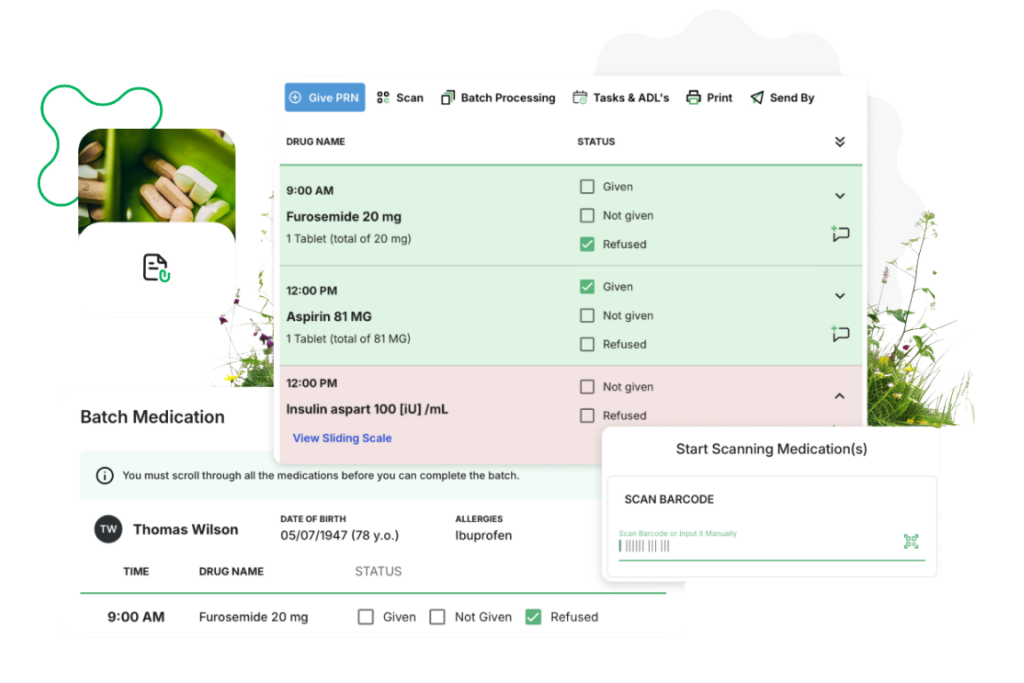
An electronic medication administration record, or eMAR, supports medication administration documentation. An electronic health record, or EHR, organizes the broader resident record, including care plans, assessments, and other health information.
The distinction matters, but so does the connection.
When a medication order changes, staff should be able to find the update and the related documentation without searching across several systems. They should not have to piece together the resident’s history from records that do not talk to each other.
Look for a clear path between medication records, progress notes, care plans, and supporting documents, with access that reflects each person’s role. Replacing a binder with a digital folder is only the beginning. The information also has to be easy to use.
Daily Responsibilities That Carry Through to the Next Shift
A care plan describes the support a resident needs. Your team also needs a practical way to organize and record that work.
Consider a recurring morning task. The caregiver should be able to find the instructions, provide the support, and document what happened. The next staff member should be able to find that entry without tracking down the person who completed it.
The same applies to documenting assistance with activities of daily living, or ADLs. Scheduled tasks, completed entries, and items still needing attention should be easy to distinguish.
A shared record does not replace communication. It gives the next conversation a clearer starting point.
Less Manual Drafting, With Your Team Still in Control
Clear documentation matters. So does making it practical for the person completing it.
Voice-to-text gives caregivers a way to speak their observations when typing is less convenient. But a prepared draft is not a finished record. It still needs to reflect what the caregiver observed and did.
The safeguard is the point. The software prepares the draft. Your team reviews, makes corrections, and decides what gets saved.
The benefit is less manual drafting, not less responsibility for the final note.
Inspection Ready Starts With Everyday Recordkeeping
Records should be easy to find before someone asks for them.
A current care plan, an earlier progress note, or a month of medication documentation should not require a search across several places. Clear dates, identifiable authors, and an understandable history of updates give your team a better starting point for regular review.
Authorized staff should also have a practical way to retrieve and share records when needed.
Software can support your efforts to stay inspection ready. Complete documentation, regular reviews, and meeting your setting’s requirements still depend on your team.
Support Should Continue After Setup
Your team needs more than a login.
During onboarding, it should be clear which records are moving, who reviews them, how caregivers learn the system, and where they can get help. Those answers matter as much as what happens during the demonstration.
Setup is not the end of the relationship, either. A caregiver who joins six months later still needs training. A manager using an unfamiliar feature still needs somewhere to turn.
Synkwise includes team onboarding training in all plans. Pro and Enterprise plans include additional ongoing training and support resources.
The useful question is not simply whether support is included. It is whether your team knows how to get help when the work is underway.
What the Transition Looked Like at Silver Acres
Danae Elsner had already used electronic charting as a registered nurse. But when she opened Silver Acres Adult Family Home, she initially followed advice to use paper.
In a testimonial published by Synkwise, she describes finding that approach too time-consuming and making the switch. She reports that staff learned the charting process quickly and that the medication administration record was clear and easy to navigate.
That is one community’s experience, not a guaranteed outcome. What makes it useful is the focus on familiar work: documenting care, finding records, and helping staff use the system comfortably.
For a closer look at evaluating platforms, Synkwise’s How to Choose the Right EHR for Assisted Living covers pharmacy workflows, onboarding, support, and other selection questions.

Software Should Fit the Community You Run
Synkwise brings medication documentation and resident care tools into one platform, including care plans, assessments, daily tasks, forms, and document management.
For your team, the value should show up in ordinary moments.
A caregiver finds the next task. The next shift can review the note. An administrator locates the record without assembling it from several places.
You do not need a larger building before that matters. You need software that fits the people doing the work, with support that makes it practical to use.
Book a demo to see how Synkwise can support your community’s daily care and documentation.
Frequently Asked Questions
Is an eMAR enough for a small care home?
An eMAR may address your medication administration documentation, but consider the rest of the resident record. Where does your team keep progress notes, care plans, assessments, and documents?
If those remain disconnected, a platform that combines eMAR with broader care documentation may be a better fit.
Can one platform support different residential care settings?
A platform can support multiple settings, but the fit depends on your community’s forms, records, permissions, and daily workflows.
Shared documentation needs do not erase differences in state requirements. Evaluate the system against the work your team does and the requirements that apply to your license.
How much does software for a small community cost?
Costs depend on your resident count, locations, features, and optional services. Synkwise offers a pricing calculator and month-to-month subscriptions.
Review the total alongside the plan details so you understand which tools, training, and support are included.
About the data: The 56.5% figure combines two rounded categories from CDC’s 2025 weighted national estimates. The study covers qualifying state-regulated residential care settings with at least four beds and excludes settings regulated exclusively for adults with intellectual or developmental disabilities, severe mental illness, or both. The separate 2020 bathing comparison measures the share of residents needing assistance, not the intensity of each resident’s needs or total staff workload. See the 2025 study methodology for its scope.